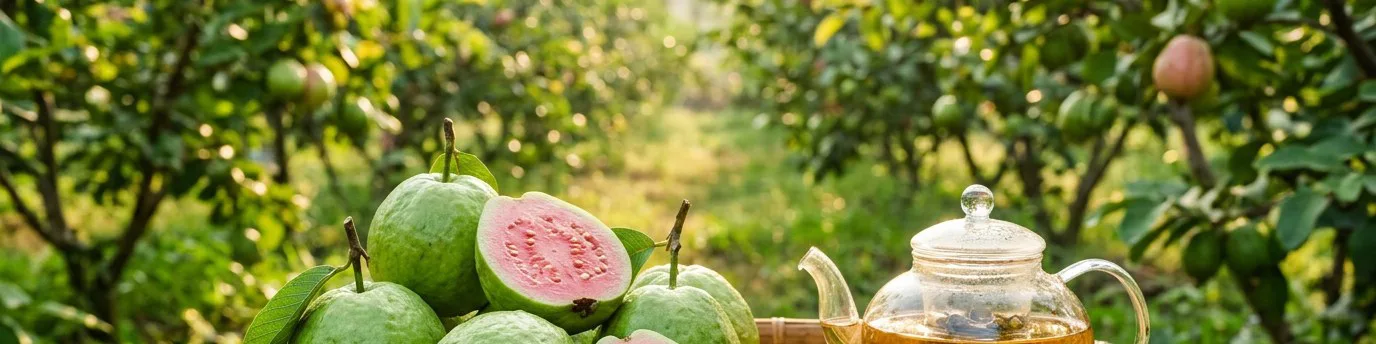
Across the commercial fruit belts of Southern Vietnam, experienced orchardists unlock the year-round bearing potential of tropical guava through intensive canopy management. Rather than letting trees shoot upward into tall, shaded tangles with sparse fruit on outer tips, growers practice systematic pruning guava trees for high yield—combining strategic tree spacing, seasonal scaffold rejuvenation, and rhythmic shoot-tip pinching so fresh flower buds emerge continuously along sunlit lateral branches.
Orchard Thinning and Rainy-Season Scaffold Rejuvenation
When renovating an older, closely spaced guava garden originally planted at 2 to 2.5 meters between trees, overcrowding often starves lower limbs of sunlight. Removing every alternate tree opens the stand to an ideal mature spacing of 4 to 5 meters, restoring airflow and light penetration across the entire block—whether cultivating classic white-fleshed cultivars or ornamental-fruited selections like ruby-fleshed red guava with purple foliage.
Schedule major structural heading back during the onset of the rainy season on the remaining trees. Retain only well-balanced level-1 primary scaffold branches radiating directly from the central trunk, sawing each primary limb back to approximately 1 meter from the main stem. Immediately coat large saw cuts with protective horticultural tree paint or lime paste to seal vascular tissue against sap dehydration, sunscald cracking, and wood-decay fungi.
Root Cultivation, Canal-Mud Top-Dressing, and Tip Pinching
Immediately after structural pruning, lightly hoe the orchard floor to a depth of 5 to 7 centimeters starting roughly 0.5 meters outward from the trunk base so surface feeder roots are aerated without severing major anchor roots. Broadcast 10 to 15 kilograms of well-rotted organic farmyard manure plus 300 grams of NPK 20-20-15 around each tree's drip line. In alluvial Mekong Delta orchards, growers then spread a thin top-dressing of fertile pond or canal mud over the fertilized ring; once that mud crust dries and develops fine surface cracks, regular irrigation keeps the root zone cool and triggers vigorous budbreak.
As new shoots flush along the shortened level-1 limbs and expand 4 to 5 pairs of leaves, train the emerging crown systematically:
- Select Strong Framework Buds: Thin out weak, crowded, or downward-pointing sprouts early, retaining 4 to 5 sturdy shoots spaced evenly around each primary scaffold limb.
- Pinch Shoot Tips Repeatedly: Pinch the soft growing tip of each chosen shoot back to 3 to 4 mature leaf pairs. Two axillary shoots will soon push from the upper nodes; pinch those new shoots again using the same leaf-count rule. The subsequent flush reliably emerges carrying paired flower buds—which set paired guavas—alongside fresh vegetative shoots.
- Maintain a Sunlit Mushroom Canopy: Repeating this sequential pinching builds a broad, dome-shaped mushroom canopy at chest height for effortless bagging and harvesting. Throughout the year, snip away senescent basal leaves and thin interior "toothpick" twigs to keep the crown ventilated and reinforce integrated pest control and guava tree care.
Seasonal Mulching and Periodic NPK Maintenance
Consistent orchard floor sanitation and moisture regulation sustain heavy fruit sizing. Keep rows weeded clean, and blanket the root zone during the dry season with dried grass, rice straw, or cured leaf litter alongside regular watering so developing guavas expand rapidly with crisp texture. Once heavy monsoon rains return, pull damp organic mulch back from the trunk collar so bark stays dry and resistant to collar rot.
Roughly 1 to 2 months after initial rejuvenation pruning and basal manuring, adopt a recurring balanced guava orchard fertilization program every 20 to 25 days to nourish swelling fruit while stimulating continuous root and flower initiation. Apply 150 to 200 grams of NPK 20-20-15 per tree per cycle according to canopy vigor, scaling nutrient rates upward as trees mature. Additional seasonal pruning and soil guides are available throughout our orchard cultivation techniques archive.