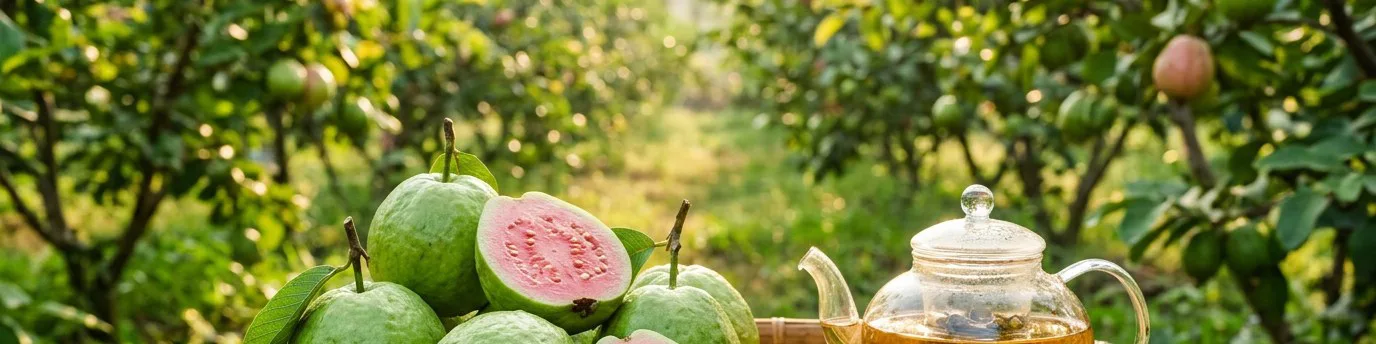
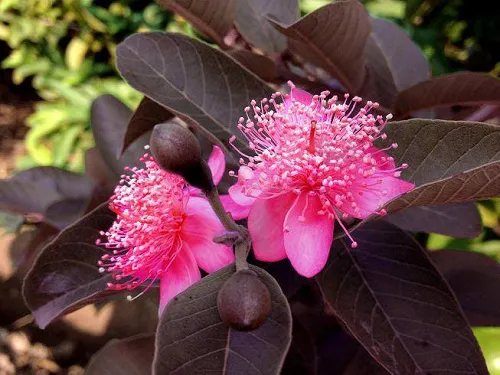
Among the exotic tropical fruit trees captivating Vietnamese courtyard gardeners and specialty orchardists, few cultivars turn heads quite like the Malaysian purple guava (ổi tím Malaysia), widely admired as the red-purple leaf guava. While ancestral Psidium species originated in southern Mexico and Central America before spreading across Pacific island chains and Southeast Asia, selective horticultural breeding in Malaysia refined this striking variety for both ornamental landscape beauty and gourmet table quality. Unlike conventional Vietnamese pink-fleshed guavas that bear green leaves and white blossoms, every aerial part of this cultivar—from its glossy burgundy-purple foliage and young stems to its cherry-blossom-pink flowers, ruby skin, and rosy interior pulp—glows with rich anthocyanin pigment.
Botanical Characteristics and Climate Adaptability in Vietnam
Growing as a compact, multi-branched evergreen shrub or small orchard tree reaching 10 to 15 feet (roughly 3 to 4.5 meters) at maturity, the red-purple leaf guava fits effortlessly into sunny rooftop containers, decorative courtyard borders, and commercial family orchards alike. Whereas heirloom regional favorites—such as those celebrated when visiting Thai Binh for authentic Bo guava harvests or managed through high-yield Queen guava planting techniques—focus on classic green-skinned crispness, Malaysian purple guava pairs year-round ornamental color with precocious fruiting:
- Rapid Precocious Fruiting: Well-tended saplings begin opening vivid magenta-pink blossoms and setting their first aromatic fruits within just 8 months of planting, noticeably faster than many traditional domestic cultivars, and adapt readily to decorative pot culture.
- Reliable Self-Pollination and Continuous Waves: Blossoms are naturally self-fertile, allowing even a single patio tree to set abundant fruit clusters that size up quickly within a few months, with main summer flowers ripening into winter harvests alongside repeat flushes throughout the year.
- Flexible Ecological Tolerance and Propagation: Well suited to Vietnam's northern and southern climates, the tree thrives in full sun (benefiting from light afternoon shade only in intensely hot, arid microclimates), provided soil moisture remains steady during flowering and fruit set. Though capable of surviving on lean soils, monthly organic feeding in humus-rich loam maximizes fruit size and sweetness, and nurseries propagate stock via grafting, air-layering, root cuttings, or vigorous seed selection.
Vietnamese Orchard Trials and Measured Nutritional Composition
When fully ripe on the branch, Malaysian purple guava releases an intensely sweet, floral tropical fragrance that stands out among existing guava varieties grown in Vietnam. After studying global cultivar collections, Vietnamese agricultural cooperatives imported authentic Malaysian mother stock and conducted five years of grafted orchard trials paired with biological pest-and-virus management protocols—confirming dependable cultivar stability, high fruit set, and average yields even from seed-grown trees that exceeded traditional Đông Dư (Gia Lâm, Hanoi) guava benchmarks.
Laboratory compositional analyses reported by Vietnamese horticultural researchers explain why this anthocyanin-dense fruit elevates the classic everyday health and skincare uses of guava documented across our guava varieties and botany archive. Fresh purple guava fruits consist of 74 to 87 percent moisture, 13 to 26 percent edible flesh solids, 0.5 to 1.0 percent total mineral ash (alongside 0.4 to 0.7 percent fine structural ash fractions), and 0.8 to 1.5 percent combined lipids and plant protein. Remarkably, its vitamin C concentration measures roughly four times higher than sweet oranges and 1.5 times higher than ordinary green guava, while levels of vitamins A and B-complex, calcium, iron, potassium, and natural antibacterial phytonutrients run 1.25 to 1.5 times higher than standard green-skinned cultivars. Rich in age-defying antioxidants and soothing leaf tannins, its bark, roots, stems, young leaf buds, and ruby fruits all remain highly valued in traditional botanical wellness.