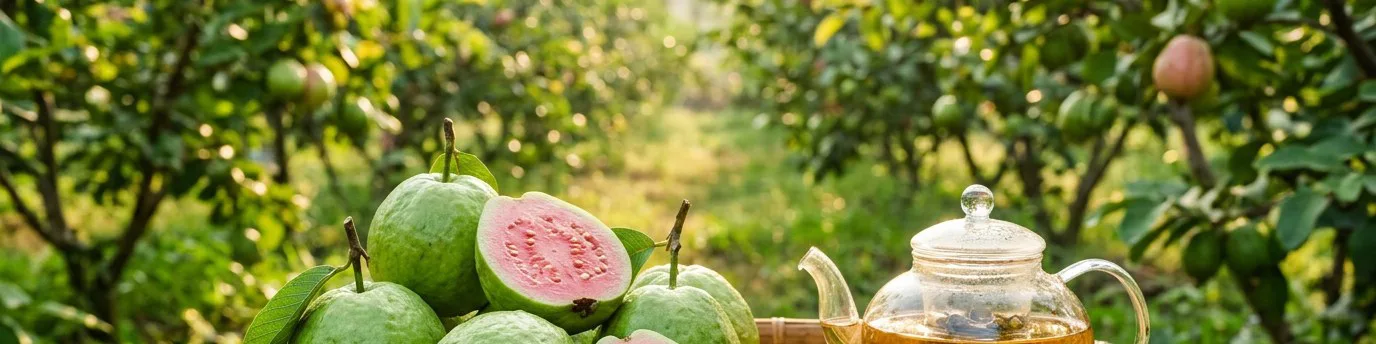
Guava trees are famously adaptable across Vietnamese agricultural regions, thriving in alluvial river silt, upland red basalt, and sandy loam alike without demanding specialized soil types. Despite this hardiness, guava roots react poorly to heavy-handed synthetic chemical feeding, especially excessive straight nitrogen, which forces soft, sappy vegetative shoots, reduces flower set, dilutes fruit sweetness, and attracts sap-sucking orchard pests. Practicing balanced guava orchard fertilization anchored in organic matter, potassium, and timed split applications keeps foliage resilient while enhancing the vitamin-rich crispness celebrated in traditional Vietnamese guava nutrition and wellness.
Soil Moisture Balance, Mineral Amendments, and Trunk Limewashing
Productive guava orchards require abundant direct sunlight paired with consistently cool, well-aerated root zones maintained at 60 to 80 percent field moisture capacity, staying evenly moist without ever sitting in stagnant waterlogged soil. When traditional farmyard manure is limited, growers can enrich planting beds with microbial organic NPK blends (supplying roughly 10 percent total nutrients) blended with 5 to 7 percent mineral coal slag or wood ash and 3 to 5 percent agricultural lime or weathered lime mortar to buffer soil acidity and sharpen fruit flavor.
As established orchard trees pass ten years of age and naturally shed rough, peeling plates of outer bark along the lower trunk, experienced growers brush saturated agricultural limewater over the lower stem. This simple seasonal practice deters bark-hiding borers and fungal spores while reflecting sunlight upward into the interior canopy to boost leaf photosynthesis, particularly in high-value blocks of commercial seedless Phugi guava trees.
Year-by-Year NPK and Organic Compost Application Guide
Adjusting nutrient ratios as young trees transition from root establishment into continuous year-round cropping prevents nutrient burn and maximizes marketable fruit weight. Coordinate every feeding cycle with structural canopy pruning for high-yield guava orchards using the proven three-stage schedule below.
- Year 1 (Root Establishment): Allocate 200 grams of NPK (16-16-8), 50 grams of urea, and 50 grams of potassium chloride (KCl) per young tree across the first year; dissolve divided portions into irrigation water and drench around the root zone 4 to 6 times annually beginning 15 to 30 days after planting.
- Year 2 (Canopy Building): Increase total annual nutrition per tree to 400 to 500 grams of NPK (16-16-8), 100 grams of urea, and 100 grams of KCl, split evenly into 4 applications spaced across seasonal growth flushes.
- Year 3 Onward (Pre-Flowering Dressings): Once fruiting stabilizes, broadcast 200 to 300 grams of NPK (16-16-8) combined with 100 grams of urea evenly around the outer root zone prior to blossom induction, then lightly hill soil over the granules.
- Year 3 Onward (Fruit-Sizing & Basal Trenching): Starting 1 to 1.5 months after pre-flowering feeding, apply light top-dressings every 15 days alongside shoot tipping across 10 cycles to nourish developing fruit; additionally, dig a circular trench 0.7 to 1.0 meter from the trunk to bury 100 to 200 grams of NPK (16-16-8), 100 grams of urea, 100 grams of KCl, and 20 to 30 kilograms of well-rotted compost, backfilling completely with soil.
Watering thoroughly immediately after backfilling fertilizer trenches dissolves nutrients smoothly into the feeder-root zone and prevents nitrogen volatilization. Explore more field-tested orchard guides throughout our Vietnamese guava cultivation techniques archive.