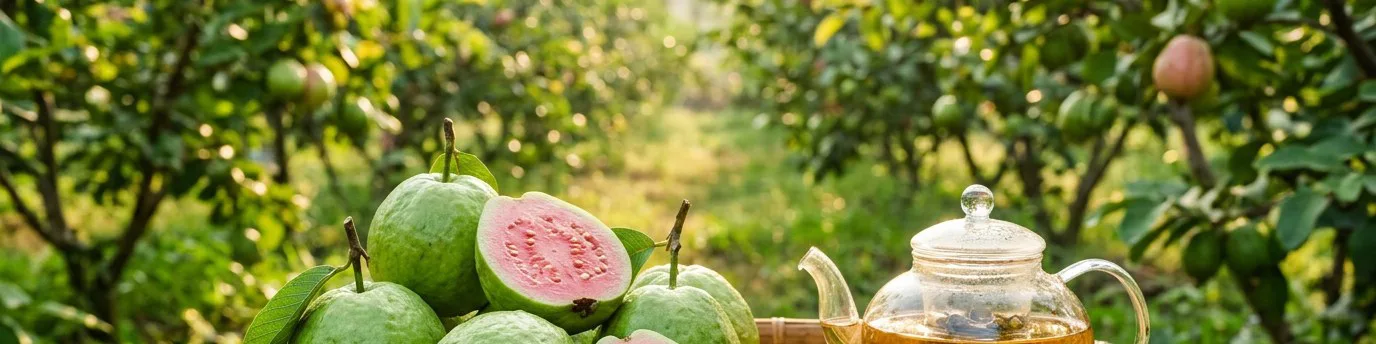
In traditional Vietnamese wellness philosophy, restoring fluid hydration, warming the core, and protecting digestive Spleen-Stomach harmony represent the three foundational priorities whenever acute digestive upsets strike. Generations of rural families have turned to a remarkably accessible kitchen preparation to support this process: a warm infusion of tender guava leaf buds paired with roasted brown rice porridge water. Across the Vietnamese countryside, the familiar image of a backyard guava tree leaning beside the garden well symbolizes more than summer shade and crisp orchard fruit. It also serves as a living household herbal pantry, inspiring time-tested guava leaf herbal remedies that complement everyday family nutrition. Homeowners interested in establishing their own courtyard tree can begin with our practical guide to planting and establishing healthy guava trees.
Botanical Profile and Sino-Vietnamese Herbal Heritage
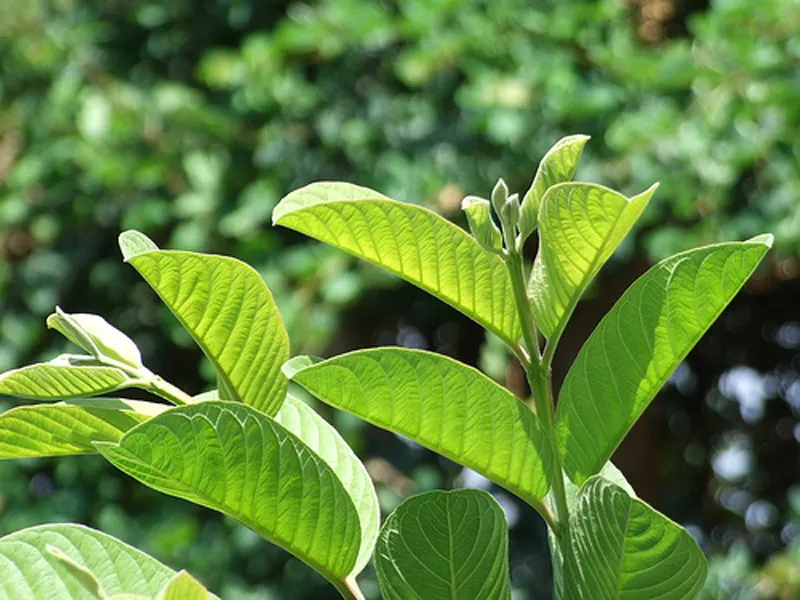
Known in classical Sino-Vietnamese botanical texts as Phan Thach Luu, the common guava (Psidium guajava L.) belongs to the aromatic myrtle family Myrtaceae. Rather than towering timber, guava grows as a resilient small-to-medium woody tree reaching 3 to 6 meters in height, making it ideal for compact homestead gardens. Its young shoots are easily recognized by their distinct four-angled, square-edged twigs. Mature leaves grow opposite one another in symmetrical pairs on short petioles, displaying oval-oblong blades with prominent parallel lateral veins and fine, soft pubescent hairs underneath.
Delicate white blossoms with clustered stamens emerge singly or in small groups from the upper leaf axils, giving way to round or pear-shaped berries with firm outer pericarp flesh. Originally native to tropical America, guava naturalized across Asian and African agricultural regions centuries ago. Today throughout Vietnam, hardy wild guavas dot sunny hillsides and alluvial plains alike, while selected sweet cultivars thrive in commercial and backyard orchards.
Antioxidant Phytochemicals, Tannins, and Quercetin Activity
Modern nutritional analyses confirm why every part of the guava plant commands respect among nutritionists and ethnobotanists. Fresh guava fruit supplies vitamins A and C, essential omega-3 and omega-6 fatty acids, and abundant soluble and insoluble fiber. Certain Vietnamese cultivars contain up to 486 mg of vitamin C per 100 grams, with ascorbic acid reaching peak concentration in the crisp outer layer immediately beneath the peel. Washing fresh guavas thoroughly and eating the fruit whole with the skin intact ensures maximum vitamin intake while keeping overall calorie intake light, an advantage highlighted in wholesome weight-management recipes featuring fresh guava.
Both the fruit and foliage are rich in two major phytochemical classes: carotenoids and polyphenols. Food scientists note that the characteristic tart, mouth-puckering astringency of unripe guava skin and young guava buds reflects dense concentrations of natural tannins. Just as deeper yellow, ruby-pink, and purple fruit pigments signal elevated carotenoid levels, stronger astringent and mildly bitter leaf notes correspond to higher polyphenol antioxidant capacity. Alongside vitamins A and C, guava leaves contain substantial amounts of quercetin, a bioflavonoid studied extensively for calming inflammatory pathways, moderating seasonal histamine sensitivity, supporting cardiovascular resilience, easing joint stiffness, and providing cellular antioxidant protection against oxidative tissue stress.
In traditional Vietnamese herbal practice, guava buds and unripe pericarp are prized for astringent tissue toning, gentle mucosal tightening, and capillary soothing, which help calm hypersecretion and reduce intestinal membrane irritation during acute watery loose stools. While tender guava buds help settle intestinal hypermotility, sipping warm roasted brown rice water simmered with slices of grilled ginger and a pinch of sea salt replenishes fluids and warms the digestive center. Laboratory investigations by Chen Liang and colleagues further identified two volatile sesquiterpenes, alpha-caryophyllene and beta-caryophyllene, that contribute to guava leaf's natural antifungal and cleansing properties. Traditional Indian herbalists likewise prepare leaf decoctions for urinary and neurological comfort, reflecting three synergistic botanical actions: astringent tissue toning, natural surface cleansing, and soothing anti-inflammatory support.
Traditional Household Preparations and Practical Precautions
Classical Eastern herbal texts classify young guava leaves and buds as neutral to mildly warming, with a sweet-sour and distinctly astringent taste profile, non-toxic nature, and traditional affinity for toning intestinal membranes and cleansing minor skin irritations. Rural Vietnamese households have preserved eight specific botanical preparations using measured amounts of buds, leaves, and dried fruit, though severe dehydration or persistent fever always warrants prompt evaluation by a qualified healthcare professional.
- Soothing minor insect bites or superficial skin scrapes: Rinse fresh young guava buds thoroughly with clean water, crush them into a clean herbal paste, and dab gently over minor bug bites after washing the skin.
- Warm herbal soak for irritated skin on limbs: Simmer approximately 100 grams of fresh guava buds and young leaves into a concentrated dark decoction, allow the liquid to cool until comfortably warm, and bathe the affected arm or leg two to three times daily.
- Oral rinses for tender gums and minor mouth sores: Crush clean young guava buds and press lightly against sensitive gums; alternatively, pound 7 tender guava buds with a splash of warm boiled water and a pinch of salt to dab gently with a clean cotton swab, or simmer 100 grams of young leaves into a warm mouthwash to swish for several minutes before spitting out.
- Warm leaf infusion for throat dryness and seasonal coughs: Lightly dry or pan-warm 20 to 40 grams of tender guava leaves and simmer in clean water as a soothing warm herbal tea throughout the day.
- Four-herb digestive decoction for acute loose stools: Simmer 20 grams of young guava buds, 20 grams of dried mangosteen pericarp rind, 10 grams of flame-grilled mature ginger, and 20 grams of golden roasted rice in water to sip warm in divided portions.
- Historical Le Minh Xuan Bach Chien Tan herbal blend: Recorded in southern Vietnamese folk herbalism for severe digestive chills triggered by damp weather or spoiled food, this traditional formula combines 200 grams of guava buds, 500 grams of cluster fig bark, 20 grams of aged tangerine peel, 100 grams of mature ginger, 10 grams of mature areca seed, and 150 grams of nutmeg, all sliced, thoroughly dried, ground into fine powder, and portioned into 6-gram packets taken three times daily with warm water.
- Crisp guava pericarp for glycemic moderation: Because outer guava flesh supplies soluble fiber, vitamin C, and polyphenols without sugary pulp, a daily 150-gram portion of crisp deseeded guava supports steady blood glucose; older adults may blend or press the fruit, though whole pieces retain fuller fiber than strained juice.
- Carbonized dried guava powder: Mature unripe guava fruit sliced, dried, and carefully roasted until darkened on the outside while retaining botanical integrity inside (sao ton tinh) is finely ground and traditionally taken in 8-gram servings twice daily with warm water for astringent digestive toning.
One essential dietary precaution applies to every household preparation: individuals prone to sluggish bowel movements or constipation should avoid concentrated guava bud teas and tannin-heavy unripe guava peels. While fully ripe guava flesh and seeds gently encourage bowel regularity, dense tannins in young buds, leaves, and unripe outer skin exert strong astringent effects that can slow intestinal transit. Readers interested in metabolic nutrition can also review balanced guava leaf and fruit routines for glycemic health alongside additional evidence-informed herbal guides across our Vietnamese guava nutrition and leaf wellness archive.