Roughly 50 kilometers northwest of Thanh Hoa City, spanning the wooded hills of Tho Xuan and Ngoc Lac districts, lies the Lam Kinh Special National Historical Relic—the ancestral homeland and eternal resting place of national hero King Le Loi (Emperor Le Thai To) alongside kings and queens of the Later Le Dynasty. Restored and honored after centuries of dynastic history, Lam Kinh draws travelers not only for its serene royal architecture, but also for the extraordinary botanical legends rooted across its vast forested grounds—most famously the smiling guava tree in Thanh Hoa whose leaves quiver at the lightest human touch.
The Tactile Mystery of the "Laughing Guava" at King Le Thai To's Tomb
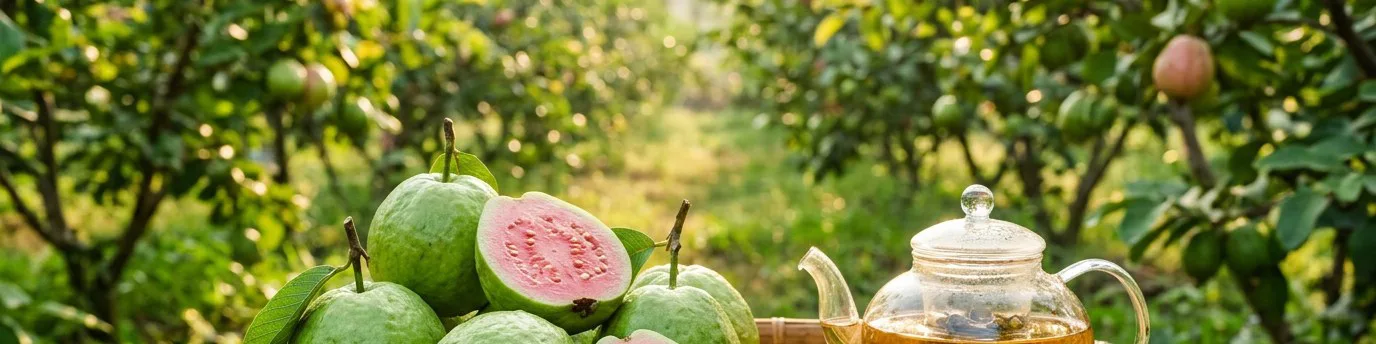
Growing right beside Vinh Lang, the royal mausoleum of King Le Thai To, stands a gnarled, nearly century-old heirloom guava tree shaped naturally like a pair of bowing dragons paying homage before the royal stone stele. Despite its weathered bark and modest height, every harvest season its slender branches still yield small, intensely fragrant ripe guavas—recalling the traditional wellness heritage celebrated in lesser-known nutritional benefits of eating fresh guava—which sanctuary caretakers respectfully gather as offerings for the royal altar.
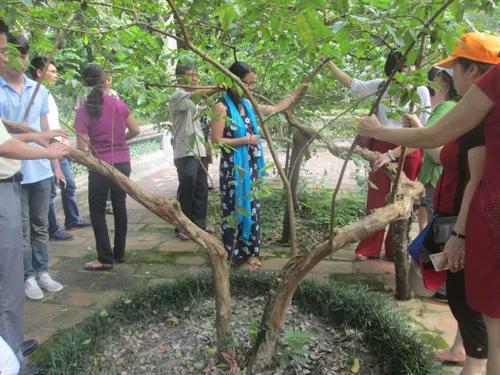
The tree's extraordinary tactile sensitivity was first discovered by visitors in 2001, and countless travelers have verified the phenomenon firsthand ever since. Even on completely still, windless afternoons when neighboring forest canopies stand motionless, if someone gently strokes or "tickles" the smooth lower trunk or root collar with a single fingertip, the tender leaf tips high across the branches immediately begin to quiver and dance in unison, looking remarkably like a person shaking with quiet laughter.
Stranger still, visitors who clasp a main branch tightly in a closed fist and shut their eyes often describe a sudden wave of lightheadedness, gentle swaying, or dizziness, as if the ground beneath their feet were rocking; visitors in delicate health sometimes feel dazed for several moments until they open their eyes and release their grip. While curious guests speculate about subtle underground geomagnetic field lines beneath the mausoleum hill, local villagers revere the ancient guava as a living wood spirit (Moc Tinh) endowed with soul and perception, believing King Le Thai To's tomb rests upon a sacred geomantic acupuncture point where heaven and earth meet. Tellingly, saplings propagated from this exact guava tree—unlike commercial trees shaped using modern pruning methods for heavy guava fruiting—show zero leaf-quivering behavior once planted outside the royal tomb precinct.
The 1933 Votive Offering and National Botanical Research
Archive records trace this heirloom guava tree back to 1933, when Mr. Tran Hung Dan from Hanh Thien Village in Nam Dinh Province traveled to Lam Kinh. Having longed for children for many years, Mr. Dan knelt in sincere prayer before the tomb of King Le Thai To and, despite his advanced years, was later blessed with a son to continue his lineage. Out of deep gratitude, he returned to present four carved stone elephants, two camphor trees, and guava trees to be planted beside the royal tomb. His descendants continue to live in Hai Phong today, where family elders note that every generation since has carried on through a single male heir. In 2008, Vietnam's Ministry of Science and Technology even commissioned a national genetic research project studying the Lam Kinh guava lineage, though scientists have yet to announce a conclusive explanation for its responsive foliage.
The 600-Year-Old Green Ironwood That Offered Its Timber to the Main Palace
The laughing guava shares the sacred forest with other revered patriarch trees. Deep inside Lam Kinh stood the forest's second-tallest giant: a healthy 600-year-old green ironwood (Erythrophleum fordii) crowned with dense emerald leaves. In 2010, immediately after preservation authorities approved the architectural project to reconstruct the historic Lam Kinh Main Palace (Chinh Dien Lam Kinh), the vibrant six-century ironwood unexpectedly shed all its green leaves at once. Roughly six months later—just as master architects completed the final structural blueprints for the palace—the solitary giant finished drying naturally while standing upright, inspiring locals to say the ancient tree had offered itself to rebuild the royal sanctuary for posterity.
During the 2011 death-anniversary commemoration of King Le Loi, Thanh Hoa Province conducted a traditional carpentry timber-blessing ceremony (Le Phat Moc) and uncovered another marvel. Whereas 600-year-old ironwoods almost invariably develop hollow heartwood, this trunk was completely solid from bark to core—perfectly suited for crafting monumental columns in Vietnam's largest nine-building traditional ironwood palace complex. Once debarked, the single tree yielded four vital architectural timbers:
- Primary Palace Mother Pillar: The lower trunk formed a grand load-bearing main column (cot cai) whose diameter matched the ancient Le Dynasty mirror-carved stone pillar plinth with uncanny precision.
- Secondary Column and Sacred Ridge Beam: Two upper boughs supplied solid heartwood for a secondary hall pillar (cot con) and the auspicious central roof ridge beam (thuong luong), enabling master joiners to complete the ironwood halls ahead of National Tourism Year 2015 hosted in Thanh Hoa.
The 300-Year-Old Symbiotic Banyan-Persimmon Heritage Tree
Rising in the southwestern corner of the inner Dragon Courtyard stands a third living witness to Lam Kinh's centuries of resilience: the 300-year-old Banyan-Persimmon tree (Cay Da – Thi). Longtime sanctuary custodians recount that a fragrant Vietnamese golden persimmon tree (Diospyros decandra) originally grew on the courtyard terrace. Centuries ago, fruit-eating birds perching high in the persimmon branches dropped wild banyan seeds into its bark crevices. As the banyan germinated and grew lush, its aerial roots did not spread outward into separate trunks, but instead embraced and fused tightly around the persimmon into one towering trunk over 20 meters tall—so massive at the base that nearly a dozen people holding hands are needed to encircle it.
For centuries, the golden persimmon remained alive right inside the banyan's leafy heart, bearing small, sweet-tart yellow fruits every autumn whose nostalgic fragrance drifted across a corner of the palace sky. Even after the ancient persimmon core finally withered in 2007—leaving weathered dry limbs visible amid the banyan's crown—the Vietnam Association for Conservation of Nature and Environment officially recognized the symbiotic giant in 2013 as a Vietnam Heritage Tree for its scale, botanical uniqueness, and historic value. Whether you love cultural tree lore or modern horticultural stories like lessons from growing seedless guava in southern Vietnam, explore our Vietnamese guava orchard and heritage news archive for more regional features.